
The field of movement disorders has been revolutionized in recent years by tremendous growth in new diagnostic information, pharmacological and neurosurgical treatments, and a deeper understanding of motor control.

With many types of movement disorders, treatment is specific to each disorder. Our treatment categories include:

Medication Management

During early stages of Parkinson’s Disease and other movement disorders, oral medications can be remarkably effective in alleviating the worst symptoms.

If symptoms do not respond well to medications or severely impair a patient’s quality of life, surgical treatment may be an option.

Deep Brain Stimulation

Deep Brain Stimulation (DBS) is a surgical procedure in which an electrode is implanted in the brain through a dime-sized hole in the skull. In some cases, electrodes are implanted on both sides of the brain when the patient’s condition affects movement on both sides of the body.

Focused Ultrasound - Available Exclusively in the Region at Rhode Island Hospital

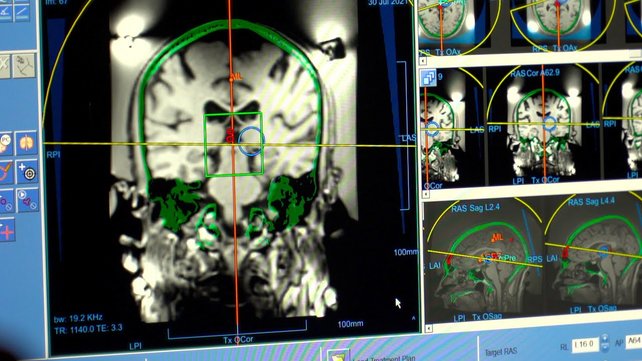
Focused Ultrasound (FUS) is a new neurosurgical technology that uses ultrasound waves to create a small ablation to disrupt the brain activity that causes tremor. Focused beams of ultrasound energy are used to target and heat specific circuits of the brain. An MRI is used to monitor the temperature of the target location while energy is delivered.

First, low energy is delivered to disrupt abnormal brain activity. When the tremor is reduced or eliminated, the temperature is then increased so that the target can be ablated, disrupting the circuit responsible for the tremor. FUS is most beneficial for those with tremor on only one side of the body, or whose quality of life will be greatly improved with one side treated.

No Incision, New Tech

Focused Ultrasound is an incisionless procedure used to treat tremors when medications are no longer effective.

older couple on laptop

Movement Disorder Program

To contact the Movement Disorder Program at Rhode Island Hospital call, 401-444-6528.