

The 2025-2030 Dietary Guidelines for Americans (DGA), released on January 7, 2026, are set to shape the diets and health of tens of millions of Americans. Here’s what’s good, what’s unexpected, and what to question in the latest DGA.
What are the Dietary Guidelines for Americans?
The Dietary Guidelines for Americans (DGA) are a framework for nutrition guidance used by the federal government to update its nutrition programs (including the National School Lunch Program; Special Supplemental Nutrition Program for Women, Infants, and Children; and Supplemental Nutrition Assistance Program); and to guide federal food policy and procurement practices, the latter for everything from correctional facilities to VA hospitals to military bases. They’re also used by health professionals, nutrition educators, the food industry, the media, and the public for food and dietary guidance.
The Department of Health and Human Services (HHS) rolled out the first DGA in 1980, and they are released every five years by HHS or the United States Department of Agriculture (USDA). As in previous years, a 2025 Dietary Guideline Advisory Committee (DGAC) of 20 independent nutrition experts spent two years preparing an evidence review for HHS officials before the new guidelines were released by the agency. The new DGA is one-tenth the size of the prior version but could make an even greater impact.
Good recommendations in the 2025-2030 Dietary Guidelines
More than other recent version, the newest guidelines confront what the healthcare community already knows: more than 80 percent of U.S. healthcare dollars are now spent on the treatment of chronic diseases, a large portion of which are diet driven, and 45 percent of cardiometabolic deaths (from heart disease, stroke and diabetes mellitus) are now linked to poor diet. The guideline boldly states what the science shows we need to remove (processed foods and beverages high in added sugars and sodium), and what we need to add back (fruits, vegetables, whole grains, and other “real foods”). Here’s the general list of recommendations:
- Eat the right amount of calories for your body (this amount varies based on age, height, sex, and activity levels)
- Prioritize high-quality, nutrient-dense protein with no additives at every meal
- When consuming dairy (more on this recommendation below), avoid versions with added sugars
- Eat mostly whole grains and limit refined grains and other refined carbohydrates
- Eat vegetables and fruits throughout the day
- Limit saturated fat to less than 10 percent of calories, and incorporate foods with healthy fats, as well as liquid oils such as olive oil
- Limit highly processed foods
- Limit added sugars to less than 10 percent of daily calories
- Limit dietary sodium to less than 2,300 mg/day
- Limit alcoholic beverages
Unexpected recommendations in the Dietary Guidelines
The 2025-2030 guidelines raise the current Recommended Dietary Allowance for protein set by the National Academy of Sciences from 0.8 grams per kilogram of body weight per day in healthy adults under age 75 to 1.2 to 1.6 grams per kilogram of body weight per day, a change not included in the 2025 DGAC report. For example, a 40-year-old adult who weighs 180 pounds (or about 82 kilograms) should aim for 98 to 131 grams of protein per day according to the new guidelines.
To achieve these targets, the new guidelines recommend eating “a variety of protein foods from animal sources, including eggs, poultry, seafood, and red meat,” and list plant protein foods (beans, peas, lentils, legumes, nuts, seeds, and soy) second. This recommendation is unexpected since numerous studies have consistently shown that plant sources of protein (beans, peas lentils, nuts and soy) have demonstrated greater health benefits compared to red and processed meats, which have been linked to gut microbial imbalances, inflammation, diabetes mellitus, cardiovascular disease and some cancers.
Moreover, the DGA graphic, interpreted by many as an upside-down pyramid, prominently displays protein from steak and ground beef in the large top row, while plant sources are de-emphasized below. Those interested in cardiovascular disease prevention should consider the recommendations of the 2025 DGAC to prioritize fiber-rich plant protein foods.
Questionable recommendations in the Dietary Guidelines
The 2025-2030 guidelines retain the limit on saturated fat at less than 10 percent of daily calories. They also advise consuming “healthy fats [from] meat, poultry, eggs, omega-3-rich seafood, nuts, seeds, full-fat dairy, olives, and avocados,” other fats “with essential fatty acids, such as olive oil” and “other options [including] butter or beef fat (tallow).”
Some of these recommendations are not evidence-based. Data from feeding trials and/or cohort studies show that saturated fats, especially butter, and beef fat to a lesser extent, raise LDL-cholesterol compared with olive oil or seed oils, and that replacing butter with healthier fats is associated with decreased risk of cardiovascular disease and death. Regarding full-fat dairy, while current data has not linked milk, yogurt or cheese to cardiovascular disease risk, LDL-C increases when cheese replaces healthier fats.
Finally, if the recommended servings of animal foods are eaten, saturated fat intake will exceed 10 percent of daily calories. Those with cardiovascular risk should consider the recommendations of the 2025 DGAC, American Heart Association and American College of Cardiology to consume fats from liquid plant oils, nuts, seeds, avocados and fatty fish.
Takeaways from the new dietary guidelines
In summary, the 2025-2030 guidelines tackle the diet-driven health crisis head on, making important recommendations to reduce sugar-laden and high sodium processed foods; however, some of the recommendations for protein and fat are not supported by current science.
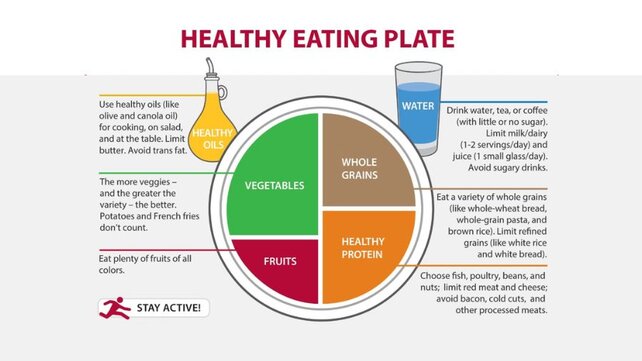
Evidence-based eating for disease prevention
For additional guidance on heart (and overall) healthy nutrition, the Harvard T.H. Chan School of Public Health’s Healthy Eating Plate can be a great visual resource for evidence-based eating for disease prevention. The graphic is also available in more than 25 languages, and the website also provides a version for children.
For extra help building a healthy eating plan, work with a registered dietitian to identify parts of your eating habits that are working for your overall health, as well as areas that could use improvement.
If you are currently working with your primary care provider or a cardiologist for heart-related conditions, talk with them about heart-healthy eating habits you can make to support or improve your heart health. For more tips on healthy eating, visit the Nourish section of the Be Well blog.



Find a Doctor