
When most people think about serious cardiovascular emergencies, they usually think of heart attacks and strokes. But there is another condition that belongs in the same conversation: pulmonary embolism (PE).
In the United States, venous thromboembolism (VTE)—a term that includes deep vein thrombosis (DVT) and pulmonary embolism—affects an estimated 900,000 people each year, and about 100,000 deaths annually are attributed to PE. That means PE is responsible for a major portion of cardiovascular deaths, right alongside heart attack and stroke.
Pulmonary embolism symptoms: what to watch for
PE can look different from person to person. Some people have mild symptoms; others become critically ill very quickly. Common symptoms include:
- Shortness of breath (dyspnea) – sudden or gradually worsening
- Chest pain – especially sharp pain that gets worse when you take a deep breath, cough, or sneeze
- Cough – sometimes with blood-tinged sputum
- Dizziness, lightheadedness, or fainting
Less common but very serious signs can include:
- Irregular heart rhythms (arrhythmias), such as atrial fibrillation
- Low blood pressure, rapid heartbeat, feeling very weak or restless
- A situation sometimes referred to as hemodynamic collapse, where the heart and circulation are failing
Because these symptoms can overlap with other conditions—like heart attack, pneumonia, or anxiety—it’s important not to ignore them. Call 911 right away if you or someone nearby has sudden shortness of breath, chest pain, or unexplained fainting. Do not try to drive yourself to the hospital.
For heart attacks and strokes, we now have well-established pathways, standardized treatments, and decades of randomized clinical trials guiding what we do. In contrast, for pulmonary embolism, there has historically been a huge unmet clinical need:
- Less standardization in how patients are triaged
- Uncertainty about who should receive advanced therapies
- Fewer large, randomized trials, because of the emergency nature of the condition
That’s exactly where the Pulmonary Embolism Response Team (PERT) comes in.
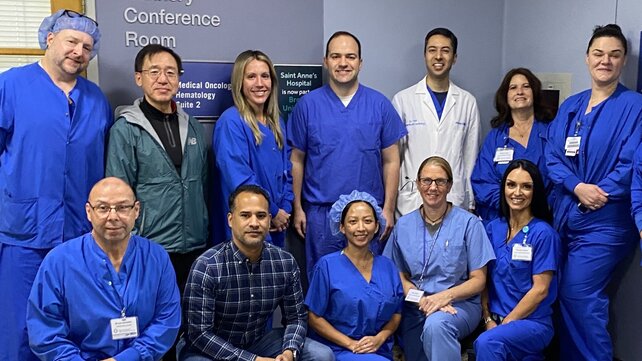
PERT at Saint Anne's
The Pulmonary Embolism Response Team at Saint Anne's Hospital works to raise awareness of PE across the hospital and community, to ensure timely diagnosis and risk stratification (deciding who is low, intermediate, or high risk), and to choose the best treatment for each patient.
What is a PERT team—and why does it matter?
A Pulmonary Embolism Response Team (PERT) brings together science, technology, and clinicians from multiple specialties to care for PE patients in a coordinated way.
At Saint Anne’s Hospital, our PERT includes experts from:
- Cardiology and interventional cardiology
- Pulmonary and critical care
- Vascular specialist
- Emergency medicine
- Radiology
- Hospital medicine and nursing
Instead of one doctor trying to make rapid decisions in isolation, the PERT model ensures that everyone who needs to be at the table is there—right away.
Together, the team works to raise awareness of PE across the hospital and community, to ensure timely diagnosis and risk stratification (deciding who is low, intermediate, or high risk), and to choose the best treatment for each patient—whether that is blood-thinning medication alone, or a minimally invasive procedure in the cardiac catheterization lab to physically remove the clot from the lungs and provide immediate relief.
The goal is simple but powerful: get the right treatment to the right patient at the right time, using the best available science and technology. The PERT model is designed to bring evolving science and cutting-edge technology to the bedside, quickly and consistently. This approach can reduce clot burden quickly while potentially preventing hemodynamic decompensation.
From Boston to Fall River: bringing advanced PE care closer to home
The first formal PERT program in the United States was launched at Massachusetts General Hospital (MGH) in 2012. For a long time, when patients in our region became critically ill with PE, the default thinking was often: “We should transfer them to Boston.”
But transferring a hemodynamically unstable (critically ill) patient with PE is not always the safest or most appropriate solution. It can:
- Delay definitive treatment
- Separate patients and families from their local support system
- Add logistical and financial burdens
Over the last several years at Saint Anne’s Hospital, we have focused on building that same level of capability here, within our own care network. Our goal has been to:
- Replicate the strengths of the highly specialized and advanced care PERT model
- Bring cutting-edge technology and multidisciplinary expertise to patients in southeastern Massachusetts and Rhode Island
- Allow patients to receive high-quality, evidence-based PE care close to home
Today, our PERT can evaluate and treat complex PE cases locally, in collaboration with regional academic partners, so that patients and families don’t always need to travel to the Boston metro area for advanced care.
Closing the loop: educating the community and learning from every case
Improving PE outcomes is not limited to what happens in the hospital—it includes what happens before and after a patient arrives. Our PERT is committed to collaborating with:
- Emergency department physicians
- Emergency Medical Services (EMS/EMT teams)
- Community physicians, including primary care providers and specialists
We do this through:
- Continuing medical education (CME) programs
- Grand Rounds and case conferences at local practices, including at the PrimaCare Medical Education Institute
- Public education sessions where patients, families, and clinicians can all learn together
These sessions focus on:
- New clinical data in the PE field
- How to recognize high-risk patients
- When to refer or transfer
- The role of newer technologies, such as catheter-based thrombectomy
This kind of feedback helps community clinicians manage future PE cases with greater confidence, while strengthening the partnership between the hospital and the broader medical community and ensuring that our patients receive the highest level of care much closer to home.
Learn more about the cardiology services at Saint Anne’s Hospital on our website.




Find a Doctor