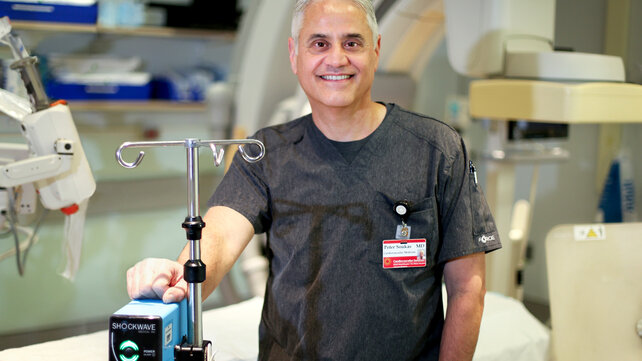
Contact Interventional Cardiology
For more information or to refer a patient for Shockwave IVL, please call 401-606-1004.

When you or a loved one receives a diagnosis of advanced heart disease, it can feel overwhelming. You may hear terms like “hardening of the arteries” or “calcified plaque.” These simply describe hard, rock like calcium that has formed inside the artery walls, making them difficult to open with standard treatments.
In the past, these hardened blockages were challenging to treat and sometimes required open heart surgery or other high risk procedures. Today, newer technology has made treatment gentler, safer, and far less burdensome for patients.
The Brown University Health Cardiovascular Institute offers Shockwave Intravascular Lithotripsy (IVL), a newer, more gentle technology that is transforming how cardiologists treat calcified arteries. It uses the same proven sound-wave technology that safely breaks up kidney stones. With IVL, tiny pressure waves are delivered from inside the artery to crack the hardened calcium without breaking into pieces and without harming the surrounding soft tissue.
Shockwave Intravascular Lithotripsy is a minimally invasive therapy designed to gently break up hard calcium inside the arteries. It is based on lithotripsy, a medical technology that has been used safely for decades to break up kidney stones.
The engineers behind IVL miniaturized this technology to fit inside a standard catheter, which is a thin, flexible tube used in heart procedures. This allows the device to travel through the blood vessels to reach the blocked artery. Once in place, it delivers tiny pulses of energy that crack the hardened calcium, making the artery easier to open and treat.
Shockwave IVL gently softens hardened calcium inside the artery while protecting the surrounding soft tissue.
During the procedure, the surgeon guides a thin catheter with a small balloon to the narrowed area of your artery. Once in place, the balloon is lightly inflated so it touches the artery walls. The device then releases short pulses of sound waves that pass safely through the soft tissue and target only the hardened calcium.
These sound waves create tiny cracks in the calcium, making the artery more flexible. This allows the balloon to open the artery more easily and helps prepare the area for a stent, if one is needed.
Because the sound waves focus on the calcium and spare healthy tissue, IVL reduces stress on the artery wall and lowers the risk of injury compared to more aggressive tools.
For more information or to refer a patient for Shockwave IVL, please call 401-606-1004.
Shockwave IVL can help people with significant calcium buildup in their arteries, especially when standard treatments have trouble opening the vessel. It is FDA approved for use in:
Your doctor will consider IVL if the calcium is hard enough to make traditional balloon treatments difficult or less effective.
In the heart, IVL is used when calcium makes a blockage too firm for regular balloons or when previous attempts did not fully open the artery. It may be considered if you have:
In these cases, IVL can help soften the calcium so the artery can be opened more safely and effectively.
IVL is also helpful when calcium builds up in the arteries of the legs, particularly the iliac, femoral, or below the knee vessels. It may be used for people who:
IVL can gently prepare these arteries so they can be opened and treated with less stress on the vessel.
Shockwave Intravascular Lithotripsy has introduced a new level of confidence and safety in treating arteries hardened by calcium. For many people, it transforms what used to be a challenging or unpredictable procedure into one that is far easier on the vessel and more reliable for long-term results.
By gently softening calcium with sound waves, IVL helps doctors fully open the artery and place stents more effectively, improving blood flow and often helping patients feel better, breathe easier, and return to their daily activities with renewed comfort.
If you’ve been told you have “hardened” or calcified arteries, or if standard stenting hasn’t been an option in the past, this newer approach may offer possibilities you didn’t have before. A conversation with your cardiologist or one of our interventional cardiologists is the best place to start. They can review your artery anatomy, medical history, and treatment goals to help you understand whether IVL may be a good fit for you.
Your health is essential, and being informed is one of the most powerful tools you have. With the right guidance and the right treatment plan, you can take confident steps toward protecting your heart and vascular health for the long term.
Understanding how IVL compares to other treatments helps clarify why your doctor might recommend it.
Traditional balloons can have a hard time opening arteries that contain a lot of tough calcium. In some cases, doctors may use “scoring” or “cutting” balloons, which have tiny wires or blades designed to create small grooves in the plaque. These tools can help, but they still struggle when the calcium is thick or deeply embedded in the artery wall.
Shockwave IVL works differently. Instead of relying on high pressure or cutting tools, IVL uses gentle sound waves to break up the calcium itself. This allows the artery to open with much less force, which means less stress and less risk of injury to the vessel wall.
Atherectomy is a tool that clears hardened plaque by shaving or sanding it down. Shockwave IVL works differently; it uses gentle sound waves to soften the calcium so the artery can open more easily.
Atherectomy can be useful in certain situations, but it’s more complex and requires specialized equipment. IVL is often simpler and treats the entire area more evenly, making it a good option for many patients with calcified arteries.
The interventional cardiologist will consult with you to determine which approach is safest and most effective for your specific artery anatomy.
Shockwave IVL offers several advantages for treating arteries with significant calcium buildup:
IVL softens both the outer and deeper layers of calcium within the artery wall, allowing the vessel to expand more effectively during treatment.
The sound waves pass safely through soft tissue, targeting only the hardened calcium and helping preserve the integrity of the artery.
By directly softening the calcium, IVL often makes challenging procedures easier to perform and helps achieve more predictable vessel expansion.
Shockwave IVL has a strong safety record and is designed to be gentle on the artery. Like any medical procedure, it does carry some risks, and the interventional cardiologist will review what applies to your specific situation.
The risks of IVL are similar to those of other common procedures such as angioplasty or stent placement. Most are uncommon and are monitored closely by your care team. These may include:
Your medical team will take steps to reduce these risks and ensure you are supported throughout the process.
While Shockwave IVL is a good option for many people, it may not be right certain cases. Your doctor will review your overall health and the shape of your arteries to determine whether IVL is the safest and most effective approach for you.
IVL may not be recommended if:
The interventional cardiologist will talk through these considerations with you and recommend the treatment that best fits your needs.
If you’re considering Shockwave IVL, it’s natural to have questions. Below are some of the most common topics patients and families ask about.
Generally, no. The procedure is usually done under sedation, so you should feel comfortable throughout. Some people notice a bit of pressure when the balloon inflates or a light “tapping” sensation from the sound waves, but it’s rarely described as painful. And despite the name, the “shockwaves” are sound waves, not electrical shocks.
Stents are designed to stay in place permanently. How well the artery stays open over time depends on two things:
Because IVL helps soften the calcium and allows the stent to expand more fully, long term results are often excellent. You’ll still need to take prescribed medications and manage risk factors such as blood pressure, cholesterol, diabetes, and smoking.
No. IVL doesn’t remove the calcium—it changes its structure. Think of it like turning a solid ring of concrete into a ring of gravel. The material is still there, but once it’s cracked, it becomes flexible and can be pushed aside so the artery can open and blood can flow more freely.
Sometimes, yes. If a stent didn’t expand fully the first time because of hard calcium or if new calcium has formed inside an older stent (called in stent restenosis), IVL may help soften the calcium behind the stent and allow it to open more. In some areas, this is considered an “off label” use, so it’s important to discuss your specific situation with your cardiologist.
Recovery is usually quick. Most patients simply rest for a few hours after the procedure and are discharged within the same day or by the next morning. Most patients can return to normal activities, including driving and work, within about a week.
If the catheter was placed in the groin, you may need to lie flat for a short time to prevent bleeding. If it was placed in the wrist, you’ll need to rest the arm for a few hours. Strenuous exercise should be avoided for 5 to 7 days to allow the access site to heal.
Yes. Shockwave IVL is FDA approved and is covered by Medicare and most private insurance plans when it is medically necessary to treat coronary or peripheral artery disease. Coverage details may vary by plan, so your care team or insurance provider can review your specific benefits with you.
Shockwave IVL can improve blood flow and relieve symptoms, but caring for your arteries afterward is just as important. Atherosclerosis is a long‑term condition, and the steps you take after the procedure play a big role in keeping your arteries open and your heart healthy.
Two key areas help support long‑term success: taking your medications as prescribed and making daily lifestyle choices that protect your heart.
If you receive a stent, your doctor will likely prescribe Dual Antiplatelet Therapy (DAPT), which is usually aspirin plus a second blood thinner such as clopidogrel (Plavix) or ticagrelor (Brilinta).
Your everyday choices can help prevent new blockages and protect your arteries:
Shockwave IVL offers a safer, more comfortable way to treat arteries hardened by calcium. By using gentle sound waves to soften the calcium inside the vessel, it helps doctors open the artery more effectively and place stents with better results.
If you’ve been told you have calcified or “hardened” arteries or if other treatments haven’t worked, IVL may be an option to consider. The right approach depends on your unique artery anatomy and overall health. The best next step is a conversation with your cardiologist or one of our interventional cardiologists. They can help you understand whether IVL fits your needs and what treatment path will best support your long term heart and vascular health.
For more information about Shockwave IVL at the Brown University Health Cardiovascular Institute, please call 401-606-1004.