
Reducing Errors
The 1999 Institute of Medicine (IOM) report, "To Err is Human," brought national attention to medical error and specifically recommended the use of simulation to support human factors training.
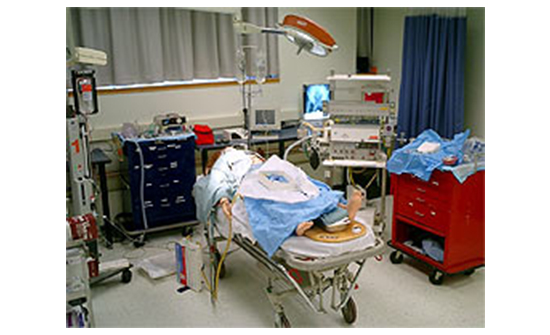
From Airplanes to the Bedside
Simulated patient care experiences were inspired by flight simulators, which have been used in pilot training for more than 50 years.
Aviation research showed that individual and team errors contribute to crashes and near misses, leading to the development of Crew Resource Management (CRM)—an annual training program that uses realistic flight simulators to improve teamwork and communication.
This successful aviation model inspired Anesthesia Crisis Resource Management (ACRM), one of the first applications of high-fidelity medical simulation in healthcare.
Today, medical simulation is widely used to improve clinical skills, teamwork, and patient safety.
Medical Simulation Reduces Errors at Local Hospitals
Locally, Rhode Island Hospital and its Hasbro Children's have been funded participants in a U.S. Department of Defense project, MedTeams, to transfer lessons learned in army aviation to medical teams in the Andrew F. Anderson Emergency Center.
This multi-center military and civilian project demonstrated the benefits of implementing a teamwork training curriculum in emergency medicine:
- Clinical error rate decreased from 30.9% to 4.4% in the experimental group.
- ED staff attitudes toward teamwork improved.
- Staff assessments of institutional support showed a significant increase.
As with the aviation experience, sustaining improved performance requires ongoing training, and this concept has contributed to the development of high fidelity medical simulation at Rhode Island Hospital.
With support from Rhode Island Hospital, the Champlin Foundation, and the MedTeams project, the Rhode Island Hospital Medical Simulation Center began operation in May 2002.