Contact The Pediatric Respiratory and Immunology Center
For more information or to make an appointment, please call 401-444-6540.

Assessing a child’s test results is the first step in creating a treatment plan that will relieve his or her symptoms. Different tests are used to diagnose various conditions. Skin tests aren’t 100 percent reliable, but they provide important information that the doctor will consider, along with other factors, to diagnose an allergy and form a treatment plan.
For more information or to make an appointment, please call 401-444-6540.
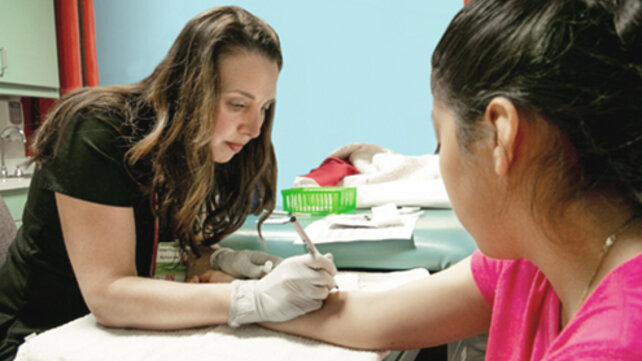
A skin prick test is used to confirm an allergy. During this procedure, the skin is exposed to an allergen through a tiny puncture or scratch. The area is observed for a reaction, such as a small hive (raised, reddened, itchy blotch). The test can confirm whether the patient reacts to something they breathe, touch, or eat. Hay fever, eczema, and allergic asthma are among the conditions skin prick tests are used to diagnose. Many allergens may be tested at one time. In adults the skin of the forearm is usually the test site; for children, the upper back is likely.
A blood test may be used if there are reasons a skin prick test isn’t possible. However, tests using blood are less sensitive and more expensive.
A skin injection test is used if an allergy to bee venom or penicillin is suspected. During this procedure, a small amount of the allergen may be injected into the skin on the arm. The spot is then observed for a reaction.
A patch test is used to check for contact dermatitis, an allergic skin disease triggered by substances such as perfumes, preservatives, metals, latex, and more. The diluted allergen is dabbed on the skin and covered with tape. The sites are examined at several time intervals to check for a reaction.
An oral challenge is used to check for allergies to food or medications. Beginning with a small amount of the suspected food or drug, the patient gradually receives larger amounts while being closely monitored in the doctor’s office. A food challenge sometimes is done to test whether a patient has outgrown a food allergy.
An allergy test should be conducted in an allergist office. Though it is very unlikely, allergy tests can trigger an extreme reaction, so it’s important to have them done in a setting where emergency treatment is readily available.
More about the Pediatric Respiratory and Immunology Center at Hasbro Children's