Thanks to the Caregivers
I could not thank the Tomorrow Fund Clinic enough,” said Emily's mother. She praised the clinic for its warmth and support.

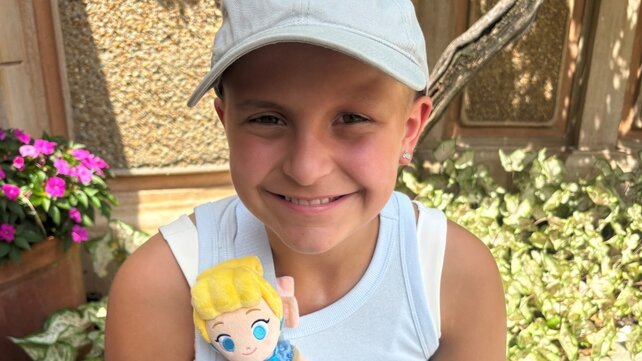
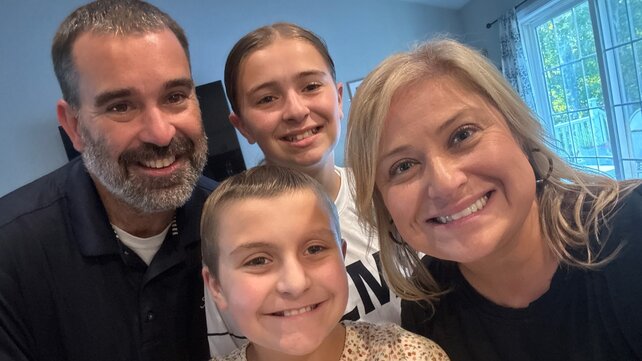
Rhabdomyosarcoma is one of those words that sounds frightening even before you know what it means. Kevin and Jamie Almeida learned how frightening it could be when their nine-year-old daughter, Emily, was diagnosed with the rare soft tissue cancer in the summer of 2024.
The first signs appeared during a family trip to Lake George, New York, when Jamie, an English-as-a -second -language teacher, noticed one of Emily’s eyes looked irritated and slightly bulged. At first, she thought it might be sand, chlorine, or lake water. But when they returned home to Freetown, Massachusetts, Jamie brought Emily to her ophthalmologist Iman Ali, MD, who referred her to Hasbro Children’s for further testing.
Imaging showed a growth near Emily’s eye, and Michael Migliori, MD, FACS, Brown University Health’s chief of ophthalmology, performed a biopsy. Soon after, Emily and her parents met with Roma Bhuta, DO, MPH, a pediatric hematologist/oncologist at Hasbro Children’s. Dr. Bhuta delivered the news that the growth was cancerous.
“As a mom and as a teacher, I tend to sugarcoat things, but this wasn’t a situation I could sugarcoat,” said Jamie.
I could not thank the Tomorrow Fund Clinic enough,” said Emily's mother. She praised the clinic for its warmth and support.
Dr. Bhuta recommended Emily join a study researching low-risk and low-risk, fusion-negative rhabdomyosarcoma. The study revealed Emily carried a genetic marker that increased the risk of her cancer recurring. Joining the study meant a longer treatment—42 weeks instead of 24—split among Hasbro Children’s, the Tomorrow Fund Clinic, and Massachusetts General Hospital in Boston.
Emily received chemotherapy at Hasbro Children’s, radiation therapy at Mass General, and occasional emergency care when treatment caused high fevers. Jamie took a leave from work to take care of her daughter full-time, while Emily’s school district provided tutoring so she could keep up with her classes.
Emily and her family relied on the Tomorrow Fund Clinic at Hasbro Children’s throughout her treatment. The clinic offers children with cancer and blood disorders a place where they can receive comprehensive outpatient care—blood draws, transfusions, chemotherapy, and supportive services—in one modern, welcoming location.
For Emily, the Tomorrow Fund Clinic felt like the right choice outside of the study requirements. “I could not thank the Tomorrow Fund Clinic enough,” said Jamie. “The environment felt warmer, and the programs offered more support for both Emily and me.”
Jamie and Kevin especially valued Hasbro Children’s child life specialists, who helped Emily pass long treatment days with games, art, and conversation.
Emily stayed connected to what she loved most: softball. Playing when she could and supporting her teammates always.
Despite months of treatment, Emily stayed connected to what she loved most: playing softball. She played as long as she could, then supported her team from the sidelines when the physical toll was too much. Her teammates and their families cheered for her in return, and when she returned to the infield after treatment, parents watching the game were moved to tears.
“She’s back to her old self—bubbly and a little sassy,” Jamie said. “It’s like she never missed a beat.”
Emily completed her treatment in June 2025. Her scans were clear. Her hair and eyebrows are beginning to grow back. She continues to get MRI and CT scans every three months as part of the study. Although the treatment is complete, Kevin and Jamie continue to feel anxious about their daughter’s health.
Reflecting on the experience, Jamie says her biggest lesson was to stay positive and preserve normal routines whenever possible. “The biggest thing I took away from this is to try to stay as positive as you can for your child,” she said. “We tried to keep normalcy and positivity, and I truly think that’s what helped us.”
Kevin and Jamie urge parents and siblings of children battling illnesses to look for help, such as medication or therapy, if they need it. “No one will judge you or think differently for doing what it takes to get you through this,” said the Almeidas.