Contact Us
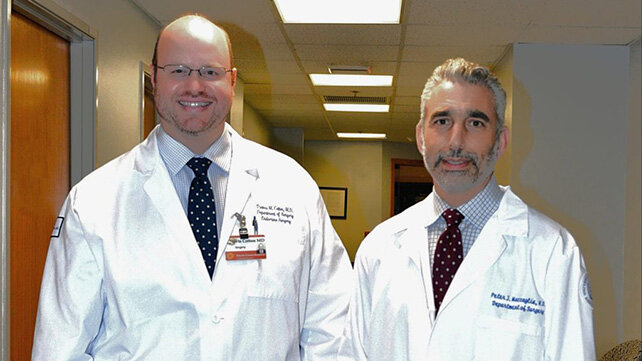
For more information about the department of endocrine surgery at Rhode Island Hospital or to refer a patient, please call 401-272-1800.

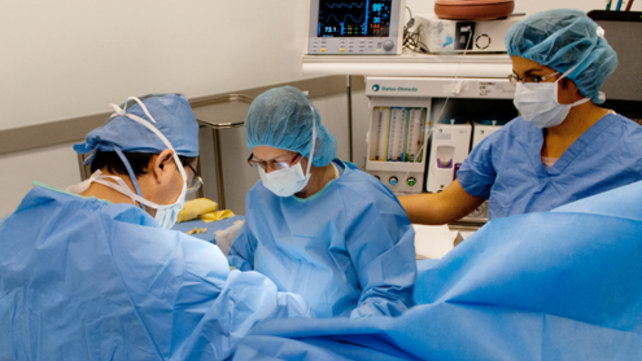
The endocrine surgery department at Rhode Island Hospital specializes in the operative management of diseases of the thyroid, parathyroid, adrenal and endocrine pancreas. Endocrine surgery treats diseases of the endocrine glands, which secrete hormones directly into the bloodstream.
For more information about the department of endocrine surgery at Rhode Island Hospital or to refer a patient, please call 401-272-1800.
Surgery for endocrine issues is typically done under general anesthesia with as minimally invasive a means possible – often using a slender fiber-optic instrument that allows your surgeon to diagnose and treat problems at the same time. In these cases, only very small incisions are required, and recovery is relatively quick with little postoperative pain.
The thyroid is a butterfly-shaped gland located at the base of your neck that produces hormones that control your heart rate, metabolism, and more. A surgical procedure called a thyroidectomy, which removes some or all of the gland, may be necessary to treat thyroid cancer, and some cases of hyperthyroidism such as Graves’ disease. The department also specializes in surgeon-performed ultrasound of the thyroid and ultrasound-guided biopsy of thyroid nodules, which can be performed at the time of initial consultation.
There are four parathyroid glands, one pair located on each side of the thyroid. They produce a hormone that controls the level of calcium in your body, which affects your bones, kidneys, and gut. Parathyroidectomy for primary hyperparathyroidism is routinely performed through a small, 3 cm incision, with minimal post-operative pain. Most patients return home on the same day. Surgeon-performed ultrasound is routinely used for pre-operative parathyroid localization.
There are two adrenal glands, each located above a kidney. These glands secrete multiple hormones including cortisol (commonly referred to as the “stress hormone”), catecholamines (adrenalin), mineralocorticoids (aldosterone), and sex steroids. Adrenal diseases include hormone secreting tumors that can cause Cushing's syndrome, pheochromocytoma, and hyperaldosteronism. Rarely adrenal tumors are primary adrenal cortical cancers or metastases from other primary tumors. The department specializes in laparoscopic adrenalectomy, which can be performed via either a trans-abdominal approach or a retroperitoneal approach
The pancreas is located behind the stomach and is attached to the small intestine. It plays an important role in your ability to digest food and control blood sugar levels. Pancreatic neuroendocrine tumors include gastrinomas, insulinomas, and other rare functioning tumors, as well as non-secreting tumors. The department specializes in the complex evaluation and management of these neoplasms.
Research is currently being conducted to learn more about endocrine diseases and how they affect our patients.
Most adrenal tumors are benign (noncancerous) and nonfunctional (not associated with hormone production) and require no treatment. Patients with nonfunctional tumors can be monitored with periodic CT scans to ensure the tumors are not growing.
Adrenal tumors that become active, or “functioning,” tend to cause an overproduction of hormones. The most common functioning adrenal tumors produce several well-recognized conditions such as:
Most hormone-secreting tumors require surgery. If cancer of the adrenal gland is suspected, an adrenalectomy (surgery to remove one or both adrenal glands) is usually necessary, and most often can be done laparoscopically (a minimally invasive surgical technique).
An abnormal enlargement of your thyroid gland is called a goiter. An enlarged thyroid can make it difficult to swallow or even to breathe.
In the U.S., overproduction or underproduction of thyroid hormones is a common cause of a goiter, as are thyroid nodules. A goiter can also be caused by insufficient consumption of iodine, a mineral needed for the body to produce thyroid hormones, although this is rare in the U.S., where iodine has been routinely added to table salt sold at the grocery store since the 1920s.
Surgery to remove part or all of the thyroid (thyroidectomy) is sometimes required to treat an especially large or symptomatic goiter.
Graves’ disease is a hyperfunctioning state of the thyroid gland. It is considered an autoimmune disorder where your body’s own immune system mistakenly attacks the thyroid gland, resulting in the overproduction of thyroid hormones (hyperthyroidism). This, in turn, can cause the thyroid gland to enlarge, resulting in a goiter.
Symptoms of Graves’ disease include heart palpitations, anxiety, tremors, high blood pressure, excess sweating, eye protrusion, and weight loss.
A thyroidectomy, or the surgical removal of the thyroid gland, is sometimes required to alleviate a patient’s symptoms.
Hyperparathyroidism is a common disorder that results from overgrowth of one or more of the four parathyroid glands that reside next to the thyroid gland. It causes the overproduction of parathyroid hormone (PTH) that in turn leads to loss of calcium from bone and increased calcium absorption in the intestine and kidney.
Possible consequences of hyperparathyroidism include kidney stones, osteoporosis, fatigue, muscle and bone pain, constipation, gastroesophageal reflux disease (GERD), depression, and decreased mental acuity.
Once a diagnosis of hyperparathyroidism is suspected due to high calcium and PTH levels in the blood, surgery to remove the affected glands is usually recommended.
Endocrine tumors of the pancreas are fairly rare. They are often found when a CT scan of the abdomen is performed for other reasons. Many of these tumors are benign, but some can exhibit malignant behavior. Sometimes they will secrete hormones that can cause symptoms of low blood sugar, peptic ulcer disease, rash, or diarrhea.
Some potential pancreatic tumors are called insulinomas, gastrinomas, glucagonomas, and VIPomas. Many of these tumors can be removed using a minimally invasive laparoscopic approach, but sometimes a more traditional “open” surgery is required.
Thyroid nodules are a solid or fluid-filled lump within the thyroid gland. The nodules are commonly discovered during a physical exam or when a radiologic study of the neck is performed for other reasons.
Most of these nodules are benign, but surgery to remove all or part of the thyroid gland may be required for large or cancerous nodules – or if the nodules are causing an overproduction of thyroid hormones.
Thyroid cancer is an abnormal growth on the thyroid gland that is malignant or cancerous.
To diagnose cancer, bloodwork, ultrasound, and often a fine needle biopsy are required. The ultrasound, specifically, can help identify whether cancer has spread to the lymph nodes. All can be performed in the office and can usually be accomplished at the time of your initial consultation.
If the biopsy indicates or confirms thyroid cancer, a thyroidectomy to remove part or all of the gland is usually necessary.