Making a Comeback after Two Strokes
In the words of Harold Ritter, “It’s really quite amazing seeing your hand going from, ‘It’s not going to move,’ to, all of a sudden, your fingers are working,”
Two years ago, Harold Ritter arrived at Rhode Island Hospital after his second stroke. The stroke left him unable to walk, limited his speech, and took away the use of his right arm. As a right‑handed person, he suddenly struggled with tasks he once did without thinking, such as tying his shoes or getting dressed.
When Harold Ritter met Wael Asaad, MD, PhD, a neurosurgeon and director of the functional neurosurgery program at the Norman Prince Neurosciences Institute, and the lead of the local arm of the RESTORE study, Harold made it clear he was ready to work.
“When I first met Harold Ritter, I was very impressed by him because it was clear that, despite the stroke, he wasn’t going to let anything get him down,” said Dr. Asaad. “He had a very positive attitude. He was eager to try new things to help himself.”
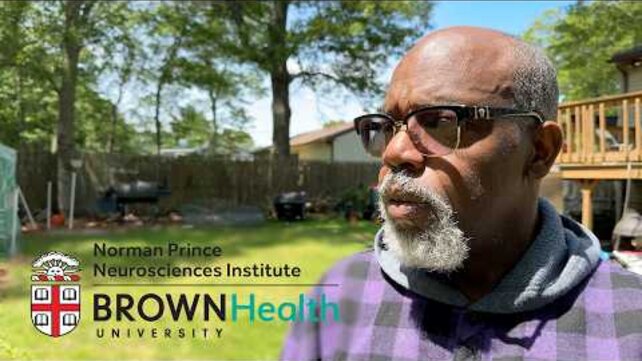
In the words of Harold Ritter, “It’s really quite amazing seeing your hand going from, ‘It’s not going to move,’ to, all of a sudden, your fingers are working,”
Ritter enrolled in RESTORE: Deep Brain Stimulation of the Cerebellum to Enhance Motor Recovery after Stroke, an 18‑month study with Brown University Health in partnership with the Cleveland Clinic. The trial examines whether deep brain stimulation (DBS) of the cerebellum can safely help people regain hand movement after a stroke.
“In this specific clinical trial, we’re hoping that deep brain stimulation targeting the motor pathways can help people who’ve had a stroke recover some of their function, specifically their hand function,” Dr. Asaad said.
For Ritter, the idea made sense. “My interest in the clinical trial became really heightened because I have a technical background,” he said. “It intrigued me to find out more about it. Not only is it an opportunity to give back if it doesn’t work for me, but it’s also a way to possibly improve myself.”
Dr. Asaad performed Ritter’s DBS surgery in two stages. First, he placed a DBS lead in Harold’s brain. A week later, he implanted a small battery under the skin of Harold’s chest and connected it to the lead. The battery sends controlled electrical stimulation to the brain.
“Deep brain stimulation is very much like a pacemaker for the brain,” Dr. Asaad said. “It’s a little battery implanted under the skin of your chest that connects to wires that go to your brain, and we target specific circuits to help with neurological problems.”
After surgery, Harold’s care team programmed the system over several sessions. Physicians used EEG readings to tune the stimulation and identify the settings that best supported Harold’s motor circuits.
Recovery did not happen overnight. Harold needed time to adjust to the device and to continue therapy. But as the weeks passed, he began to notice changes.
“It’s really quite amazing seeing your hand going from ‘it’s not going to move’ to, all of a sudden, your fingers are working,” he said. “It’s really an exciting process.”
Researchers believe the combination of DBS and rehabilitation, not DBS alone, drives improvement.
Today, Ritter uses his right hand more often and with more confidence.
“What they’re doing here is phenomenal,” he said.